--------- Top Digital Nomad Visas in 2026 (Portugal, Croatia, Estonia & More)
Mar 2, 2026
Share this article:
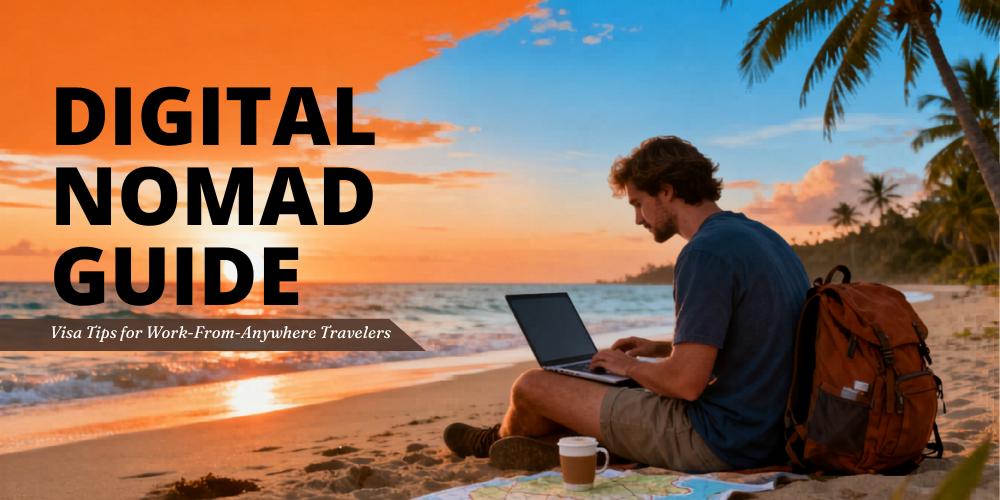
Remote work isn’t a trend anymore — it’s infrastructure. By 2026, governments aren’t just tolerating location-independent professionals; they’re actively designing immigration pathways to attract them. Long-stay digital nomad visas have matured from pandemic-era experiments into structured residency tracks with clearer rules, longer durations, and more competitive perks.
The rise of long-stay remote work visas
Countries now see remote workers as low-impact, high-spend residents. The result: visas stretching from one year to multi-year stays, often with renewal paths and streamlined applications. Faster processing and clearer eligibility rules signal a shift from pilot programs to permanent migration policy tools.
What makes a visa “top tier”
Across programs, three factors separate the standouts:
Income thresholds: High enough to signal economic contribution, but realistic for global professionals
Lifestyle proposition: Cost of living, climate, safety, and community
Mobility perks: Especially regional travel access and renewal pathways
When these align, a visa moves from “permission to stay” to a genuine relocation strategy.
Quick snapshot of leading destinations
In 2026, Europe continues to dominate the conversation.
Portugal pairs lifestyle appeal with a structured residency path
Croatia stands out for longer stays and tax advantages
Estonia remains a magnet for tech-leaning professionals
Together, they illustrate how different policy priorities — lifestyle, duration, or digital infrastructure — shape the nomad landscape.
A digital nomad visa is a residence authorization designed specifically for people who earn income remotely from clients or employers outside the host country. It formalizes what used to happen in a legal gray area: working online while staying on short-term visas.
How it differs from tourist or traditional work visas
Tourist visas: Allow short stays but typically prohibit work, even if the employer is abroad
Work visas: Usually require a local employer sponsor
Digital nomad visas: Sit in between — legal stay plus permission to work remotely for foreign income sources
The structure acknowledges that economic participation no longer requires physical presence in a local labor market.
Core eligibility themes
While details vary, most programs converge around similar criteria:
Proof of stable remote income above a minimum threshold
Health insurance valid in the host country
A clean criminal record
Evidence of accommodation or address
These requirements aim to ensure applicants are financially self-sufficient and administratively low risk.
Why countries are competing for remote talent
For governments, digital nomads represent a favorable economic equation:
Local spending without job market competition
Potential long-term residents who may transition into investors or entrepreneurs
Global visibility as a remote-work hub
In policy terms, nomad visas are a soft-power tool as much as an immigration pathway.
Who it’s for Non-EU remote employees, freelancers, and entrepreneurs with stable foreign income who want a base with long-term residency potential.
Income and savings thresholds Applicants must show a roughly €3,680 monthly income and savings of about €11,040, signaling financial stability.
Stay options
A 1-year temporary stay permit, or
A residency pathway starting with a short-term visa that converts into a 2-year renewable residence permit
Key benefits
Regional travel flexibility
Ability to include family members
A structured route that can align with longer-term residency goals
Processing and application Applications are typically lodged through consulates with supporting documents (contracts, bank statements, insurance, and accommodation proof). Processing can take up to about 60 days.
🇭🇷 Croatia — Digital Nomad Residence Permit
Updated duration rules Recent updates allow eligible nomads to stay up to three years, positioning the program among the longest in Europe.
Income range and tax advantages Applicants generally need to demonstrate a monthly income in the ~€2,539 to €3,295 range. A major draw is the absence of local income tax on qualifying foreign earnings during the stay.
Application process The process is largely digital, requiring proof of remote work, income verification, insurance, a local address, and background checks. Approval commonly arrives within three to four weeks.
Extension possibilities If the initial permit is shorter, extensions can be granted, typically allowing an additional up to six months depending on circumstances.
🇪🇪 Estonia — Type D Digital Nomad Visa
Ideal applicant profile Remote professionals, founders, and tech workers who value digital infrastructure and streamlined government services.
Income requirement and costs Applicants must show around €3,500+ monthly income over the prior six months. Total government fees generally remain under €500, making it one of the more cost-efficient European options.
e-Residency advantage A unique differentiator is the ability to pair the visa with e-Residency, enabling remote entrepreneurs to manage EU-based companies digitally.
Post-arrival steps After entry, holders complete local registration formalities, such as address registration, to maintain a compliant status during the stay.
Other Strong Digital Nomad Visa Options
🇪🇸 Spain
Income requirement and qualification criteria Applicants typically need to show at least about €2,310 in monthly income, alongside proof of remote work relationships. Many cases also require either several years of professional experience or a relevant degree, reinforcing the program’s focus on established professionals.
Length of stay and renewal path The visa commonly starts with a 1-year authorization that can extend into multi-year residence, with potential renewals reaching up to five years total, depending on compliance and continued eligibility.
Lifestyle and regional flexibility One of Spain’s biggest advantages is geographic diversity — from major urban tech ecosystems to slower coastal living. This flexibility allows nomads to tailor cost of living and lifestyle without changing visa status.
🇬🇷 Greece
Solo vs family income thresholds Income requirements sit around €3,500 per month for a solo applicant, rising to roughly €4,830 when including dependents, reflecting the program’s family-friendly design.
Permit duration and extensions The visa generally grants a 1-year residence permit, with extensions typically available for up to two additional years, provided income and compliance conditions remain met.
Why does it appeal to remote workers? Greece balances relatively straightforward eligibility with a strong lifestyle proposition — warm climate, established expat communities, and a cost structure that can be competitive compared to Western Europe.
🇨🇷 Costa Rica
Tax-free period and duration The program is notable for offering up to two years of stay with exemptions on local income tax for qualifying foreign earnings, a major draw for location-independent professionals.ww
Flexible proof of remote work Compared to many European programs, documentation standards are often more flexible, focusing on demonstrating stable remote income rather than strict employment categories.
Lifestyle draw for nomads Costa Rica’s appeal is rooted in the quality of life: nature access, established nomad hubs, and a reputation for stability in the region, making it attractive for those prioritizing environment over urban density.
Start with the practical baseline: income thresholds and cost of living. Some destinations offer lower financial barriers but higher living expenses, while others strike the opposite balance. The right choice aligns your earnings stability with the lifestyle you actually want to sustain.
Tax considerations
Tax treatment can materially change the value of a visa. Programs with exemptions or territorial tax systems may suit short-to-mid-term stays, while others are better aligned with eventual residency planning.
Long-term residency goals
If your objective is eventual permanent residence or citizenship, prioritize visas with clear renewal pathways and residency accumulation rules. Not all nomad visas are designed as stepping stones.
Mobility within Europe vs beyond
For those prioritizing regional movement, European visas offer strong cross-border travel convenience. Others may prioritize climate, nature, or lower-density living outside Europe, even with less regional mobility.
While each program has its nuances, digital nomad visa applications tend to follow a broadly similar administrative blueprint.
Typical paperwork checklist
Across destinations such as Portugal, Croatia, and Estonia, applicants usually prepare:
Valid passport with sufficient validity
Proof of remote employment or freelance contracts
Income verification (bank statements, payslips, or invoices)
Health insurance covering the stay period
Proof of accommodation or local address
Criminal background or police clearance
Completed visa application forms and fees
These documents demonstrate financial self-sufficiency and compliance with local residency rules.
Average processing times
Processing speed varies by jurisdiction and application channel, but typical ranges include:
Around 3–4 weeks for streamlined online systems
About 30 days for embassy-processed visas
Up to roughly 60 days, where additional residency steps are involved
A planning timeline of at least two to three months remains prudent.
Common pitfalls
Submitting insufficient income evidence or inconsistent bank records
Overlooking insurance coverage requirements
Providing accommodation proof that doesn’t meet local standards
Applying too close to the intended travel dates
Most delays stem from documentation gaps rather than eligibility issues.
Key Takeaways: Which Visa Fits Which Nomad Profile
Different programs excel for different priorities — the “best” visa is ultimately situational.
Best for affordability
Nomads prioritizing lower income thresholds and manageable living costs often gravitate toward options with moderate financial requirements and flexible documentation.
Best for long stays
Programs offering multi-year permissions — notably those with extended residence durations — suit professionals seeking stability rather than frequent relocation.
Best for tech entrepreneurs
Digitally advanced ecosystems, particularly in places like Estonia, stand out for founders and remote builders who value digital governance and business infrastructure.
Best for families
Destinations with clear dependent inclusion rules and higher income thresholds — such as Portugal and Greece — tend to offer smoother pathways for relocating with partners or children.
Final Thoughts
The expansion of digital nomad visas reflects a broader shift in how countries compete for human capital. Instead of focusing solely on investors or traditional migrants, governments are positioning themselves as platforms for mobile professionals — blending immigration policy with economic strategy.
For applicants, the opportunity set has never been wider, but neither needs due diligence. Rules, thresholds, and tax interpretations can evolve quickly, so always confirm requirements directly with official consulates or embassy guidance before applying.
In a landscape defined by flexibility, the most successful relocations start with accurate, up-to-date information and a clear understanding of your long-term goals.
FAQ: Digital Nomad Visas in 2026
1. What is the easiest digital nomad visa to get in 2026? “Easiest” typically depends on your income stability and readiness with documentation. Programs with moderate income thresholds and straightforward online applications — such as those offered by countries like Croatia — are often perceived as more accessible, provided applicants can clearly prove remote income.
2. Do digital nomad visas lead to permanent residency or citizenship? Some do, but not all. Certain pathways, including options in Portugal, can contribute toward long-term residency timelines, while others are designed strictly for temporary stays without direct settlement routes.
3. Can I bring my family on a digital nomad visa? Many programs allow dependents, but income thresholds usually increase. Countries with structured family inclusion frameworks — such as Greece — require higher proof of funds to ensure financial stability for the household.
4. Do I have to pay local taxes while on a digital nomad visa? Tax treatment varies widely. Some jurisdictions provide exemptions on foreign-earned income, while others may trigger tax residency depending on the length of stay. It’s important to review local tax rules or consult a professional before relocating.
5. How long does the application process usually take? Most digital nomad visa applications take between three weeks and two months, depending on whether the process is online or handled through an embassy and whether additional residency steps are required.
Welcome to the VisaTravel blog. We know that navigating the maze of visa applications and online forms can be as tricky as choosing the perfect travel playlist (which is all we want you worrying about anyway).
Throughout our years of experience, though, we’ve uncovered a mountain of knowledge which, via this blog, we’re sharing with you! Whether you're diving into the world of travel visas, wondering about the ESTA online hustle, or just trying to figure out the DS160 form, think of us as your online concierge, here to make the process easy and most of all, clear.
At this point in our global context, who has time for endless paperwork and confusing legal jargon? No one. That's why we're all about spilling the tea on online visa hacks, easier-to-work-with DS160 forms, and giving you tips on everything from tourist visas to immigration, to that last-minute ESTA online adventure.
So, just plug in a word you’re curious about on the search bar, and boom. We've got the tips, tricks, and insider info to help you (and anyone else you may be traveling with) get to your travel destination with the confidence of a seasoned traveler.

 U.S. Visa
 Canada eTA
 Schengen Visa
 New Zealand eTA
 United Kingdom eTA
 Australia eVisitor
 Vietnam eVisa
 Egypt eVisa
 Singapore Arrival Card
 Sri Lanka eVisa