
 U.S. Visa
 Canada eTA
 Schengen Visa
 New Zealand eTA
 United Kingdom eTA
 Australia eVisitor
 Vietnam eVisa
 Egypt eVisa
 Singapore Arrival Card
 Sri Lanka eVisa



--------- Visa Tips for Work-From-Anywhere Travelers (2026 Digital Nomad Guide)
Mar 18, 2026
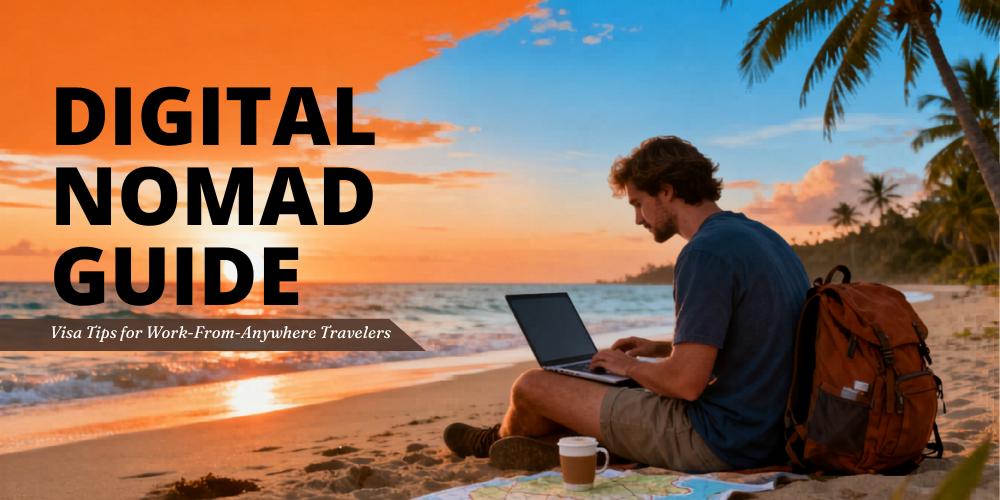
The Wi-Fi is strong. The coffee is stronger. You’re answering emails with sand between your toes, a mountain ridge behind your Airbnb, or the low hum of a café in a city you can’t quite pronounce yet. This is the fantasy—work untethered, life unboxed.
But here’s the friction nobody puts on Instagram: remote work is global, visas are not.
You can log in from anywhere—but legally living there? That’s a different game entirely. Borders still care. Governments still track. And that dreamy “I’ll just stay another month” can quietly drift into a gray zone you don’t want to explain at immigration.
So the real question cuts through the aesthetic:
How do you actually live and work anywhere—legally?
Enter the modern fix: digital nomad visas. Built for this exact lifestyle. Designed to let you earn abroad while living abroad—without breaking rules. But like anything involving bureaucracy and borders, the magic is in the fine print.

What “Work-From-Anywhere” Really Means (Legally Speaking)
Let’s get clinical for a second—because this is where most people get it wrong.
A digital nomad isn’t just someone with a laptop and a boarding pass. Legally, it’s someone earning income from outside the country they’re physically in. No local clients. No local payroll. Just foreign income, remote execution.
A tourist, on the other hand, is exactly that: visiting, not working. Even if your boss is in another country, many governments still classify “working while on a tourist visa” as a violation. It’s not about where your employer is—it’s about what you’re doing on their soil.
Then there’s the expat: someone who relocates long-term, usually tied to a local job or company. Different paperwork. Different expectations. More permanence.
Here’s the kicker: tourist visas ≠ permission to work remotely. Not officially. Not safely. Not sustainably.
That’s why digital nomad visas have exploded—over 50 countries and counting by 2026. Governments have done the math. Remote workers bring income in, not take jobs out. They rent apartments, buy groceries, pay for co-working spaces—and never touch the local labor market.
In other words, you’re economically useful without being competitively disruptive.
And that’s exactly the kind of traveler countries want.
The Visa Landscape: Your Options Decoded
Digital Nomad Visas (The Main Player)
This is your golden ticket—the visa category built for the borderless worker.
Most digital nomad visas let you stay anywhere from 6 months to 5 years, often with renewal options baked in. Some start short and extend. Others offer a clear runway toward residency.
The core rule is simple but strict:
You can work remotely—but not for local employers.
Your income must come from abroad. Your clients must live elsewhere. Break that rule, and the visa collapses.
Think of it as a legal sandbox: you can live fully in the country—but economically, you exist outside it.
Standout Programs to Know
Not all nomad visas are created equal. Some are lifestyle plays. Others are long-term strategies.
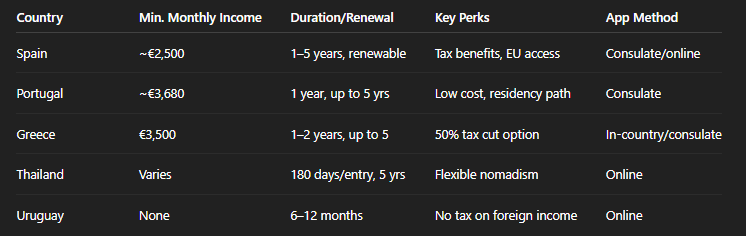
- Spain: A heavyweight. Offers up to five years and a potential pathway to residency. Add tax incentives and EU mobility, and it’s a serious contender for those thinking beyond the short term.
- Portugal: The crowd favorite. The D8 visa blends relatively accessible income thresholds with a high quality of life—and a clear route to staying longer if you choose.
- Greece: Sun, history, and a sharp financial hook—a possible 50% tax reduction for qualifying applicants. It’s not just scenic; it’s strategic.
- Thailand: Built for flexibility. The Destination Thailand Visa (DTV) allows multiple entries with generous stay periods, ideal for nomads who don’t like sitting still.
Each of these isn’t just a visa—it’s a different version of the same life.
Beginner-Friendly Destinations
If you’re new to the nomad game, complexity is your enemy. These countries keep things simple.
- Uruguay: No minimum income requirement. Minimal friction. A rare “just show up and prove you’re remote” approach that lowers the barrier dramatically.
- Sri Lanka: Affordable, accessible, and surprisingly family-friendly. Lower income thresholds make it an attractive entry point for freelancers and early-stage remote workers.
These are your training grounds—the places where you figure out the rhythm before committing to stricter, higher-stakes programs.
How to Actually Apply (Without Losing Your Mind)
This is where the dream meets bureaucracy—the paperwork phase that quietly decides whether your “new life abroad” starts in 30 days… or gets stuck in limbo.
The good news? It’s predictable. The bad news? Only if you respect the process.
Step 1: Check Your Work Setup
Before you even glance at an application form, audit your income like an immigration officer would.
If you’re employed, you’ll need explicit or at least documented approval that your role is fully remote and can be performed internationally. Some countries will ask for employer letters confirming exactly that—no ambiguity, no “temporary arrangement.”
If you’re freelance or running your own operation, the burden shifts to proof. Contracts. Client agreements. Payment history. The more consistent, the better.
And here’s the non-negotiable:
Your income must be location-independent.
That means:
- No reliance on local clients
- No in-country employment contracts
- No gray areas about where your money comes from
If your income depends on your location, the visa won’t be approved.
Step 2: Build Your Document Stack
Think of this as your credibility file. Every document answers one silent question: Are you stable, legitimate, and low-risk?
Here’s what typically makes the cut:
- Valid Passport
Usually, with at least 6–12 months before expiration. Some countries are stricter than others—don’t gamble here. - Proof of Remote Work
Contracts, pay slips, invoices—anything that shows ongoing, legitimate income from abroad. - Financial Proof
Expect to demonstrate $2,000 to $5,000+ in monthly income, depending on the country. Not projections—verified history, usually over the past 3–6 months. - Health Insurance Coverage
Minimum coverage is often $30,000 or more, including emergencies. Basic travel insurance won’t cut it. - Clean Criminal Record
Police clearance, often apostilled or notarized. This is where many applications quietly fail. - Accommodation Proof
A lease, hotel booking, or even a formal address declaration—proof that you’re not landing without a plan.
Stack these right, and your application reads like a low-risk investment. Stack them poorly, and it reads like uncertainty.
Step 3: Submit the Application
Now comes the execution.
You’ll typically have three routes:
- Online platforms (fast, streamlined, increasingly common)
- Consulate/embassy applications (more traditional, sometimes stricter)
- In-country applications (enter as a tourist, then convert—allowed in select destinations)
Processing times vary wildly:
- Fast-track cases: ~20–30 days
- Standard timelines: 1–3 months
- Complex or backlogged: longer than you’d like
Timing matters. Apply too early, and documents expire. Too late, and your travel plans collapse.
And then there’s the wildcard: visa consultants.
Use them when:
- Requirements are unclear or constantly changing
- You’re dealing with translations, notarizations, or legal nuances
- You simply don’t have the margin for error
They won’t guarantee approval—but they will reduce friction.
Where Should You Go? A Country-by-Country Snapshot
Not all visas are built for the same kind of life. Some prioritize affordability. Others reward high earners. Some are stepping stones to residency; others are pure lifestyle plays.
So before you pick a destination, filter through four lenses:
- Income requirements (Can you qualify?)
- Duration & renewal (How long can you stay?)
- Perks (Tax breaks, residency paths, flexibility)
- Ease of application (Friction vs simplicity)
Quick Comparison Table
How to Choose Your Ideal Destination
This isn’t just about getting approved—it’s about staying sane once you arrive.
- Cost of Living vs Income Threshold
A visa might require €3,000/month—but does the country actually need that much to live well? Sometimes you’re overpaying for access. - Time Zone Alignment
If your clients are asleep while you’re working, burnout isn’t far behind. Geography still dictates your schedule. - Lifestyle Match
Are you chasing city energy, beach calm, or slow, rural living? The wrong environment can turn a dream visa into a daily grind. - Long-Term Residency Potential
Some visas are dead ends. Others quietly open doors to permanent residency—or even citizenship.
Choose like you’re building a life, not booking a trip.
Taxes, Money & The 183-Day Trap
This is where things get expensive—fast.
Most countries use a simple trigger:
Stay more than 183 days, and you may become a tax resident.
That means your global income—not just what you earn locally—could fall under that country’s tax system.
Now layer in complexity: you might still owe taxes back home.
Enter double taxation treaties—agreements between countries to prevent you from being taxed twice on the same income. They don’t eliminate taxes, but they redistribute who gets paid.
For U.S. citizens, there’s a powerful lever: the Foreign Earned Income Exclusion (FEIE). Qualify, and a significant portion of your foreign-earned income can be excluded from U.S. taxation. But the rules are strict, and the paperwork isn’t forgiving.
So what’s the strategy?
- Track your days obsessively
One extra week can change your tax status entirely. - Build a 3–6 month financial buffer
Visa fees, relocation costs, deposits—it adds up before you even settle in. - Diversify your income streams
One client drops, and your entire visa eligibility could wobble. Stability isn’t optional—it’s structural.
At this level, being a digital nomad isn’t just freedom—it’s financial architecture.
Get it right, and you’re living globally with precision. Get it wrong, and you’re explaining yourself to two tax authorities at once.
Mistakes That Get Applications Rejected (Fast)
If approvals are about credibility, rejections are about cracks—tiny inconsistencies that signal risk. Immigration officers aren’t looking for perfection; they’re looking for predictability. Miss that, and your application drops fast.
Financial Missteps
This is the number one deal-breaker.
- Using Projected Income Instead of Verified Earnings
Future contracts, expected deals, “about to sign” clients—none of it counts. Authorities want historical proof, typically 3–6 months of consistent income. If it hasn’t hit your account yet, it doesn’t exist. - Weak or Inconsistent Bank Statements
Irregular deposits, sudden spikes, or unclear income sources raise flags. Stability is the metric. Clean, repeatable inflows from identifiable sources—that’s what gets approved.
Documentation Errors
This is where technically qualified applicants lose out on details.
- Missing Apostille or Notarization
Some documents—especially criminal records—must be legally authenticated. Skip this step, and your paperwork is considered incomplete, no matter how strong the rest is. - Inadequate Insurance Coverage
Basic travel insurance won’t pass. If your policy doesn’t meet minimum coverage (often $30,000+) or lacks emergency protection, it signals liability—and that’s an automatic no.
Strategic Mistakes
Even with perfect documents, poor timing or decisions can sink the application.
- Applying Too Early or Too Late
Apply too early, and documents expire before processing. Too late, and you risk overstaying or scrambling timelines. There’s a narrow window—usually within 1–3 months before your intended move. - Overlapping Visas
Holding or applying for conflicting visa types creates legal ambiguity. Immigration systems don’t like gray zones—they default to rejection. - Taking Local Clients (Breaking Visa Rules)
This is the silent killer. Digital nomad visas are built on foreign income only. The moment you engage local clients, you’re no longer compliant—and that can invalidate both your application and your stay.
Pro Tips for a Smooth Nomad Transition
Getting approved is one thing. Living well after approval? That’s a different skill set.
- Track Visa Rule Updates via Official Sources
Requirements shift—quietly and often. Always verify through government portals, not outdated blog posts or secondhand advice. - Match Destination to Your Income + Lifestyle Reality
Don’t chase aesthetics. A low-cost-of-living country with a manageable income threshold will outperform a “dream destination” that strains your finances. - Think Beyond the Visa
Ask the real questions:- Is the healthcare system reliable?
- Is the internet stable enough for daily work?
- Is there a community—or are you isolated?
- A visa gets you in. Infrastructure determines whether you stay.
- Start Simple Before Scaling
First-time nomads should prioritize low-barrier countries. Learn the system, understand your rhythm, then graduate to longer-term or more complex residency pathways.
Key Takeaways: Your Fast-Track Cheat Sheet
If you strip everything down, here’s the playbook:
- Best for long-term stay: Spain / Portugal
- Best for flexibility: Thailand
- Best for beginners: Uruguay / Sri Lanka
- Biggest risk: Ignoring tax rules (especially the 183-day threshold)
- Golden rule: Prove stable, consistent, foreign income—everything else builds on that
Final Thoughts: The New Geography of Work
Remote work isn’t a loophole anymore—it’s an emerging system with its own rules, incentives, and gatekeepers.
Countries aren’t resisting this shift. They’re competing for it. Designing visas, lowering barriers, offering tax breaks—all to attract a new class of worker who earns globally and spends locally.
And that changes the equation.
The real flex isn’t just working from anywhere.
It’s doing it legally, strategically, and sustainably—with a setup that doesn’t collapse at the first immigration checkpoint.
Because in this new geography of work, freedom isn’t about movement.
It’s about structure.
FAQ: What Every Work-From-Anywhere Traveler Needs to Know
1. Can I work remotely on a tourist visa?
Short answer: technically, no. Most countries do not allow any form of work—even for foreign employers—on a tourist visa. While some travelers take the risk, it exists in a legal gray zone. If you want stability (and zero stress at immigration), a digital nomad visa is the clean, compliant route.
2. How much income do I need to qualify for a digital nomad visa?
It depends on the country, but most programs require proof of $2,000 to $5,000+ per month in stable, foreign-sourced income. The key isn’t just the amount—it’s consistency. Expect to show at least 3–6 months of verified earnings through bank statements or contracts.
3. Do digital nomad visas lead to permanent residency?
Some do, some don’t. Countries like Spain and Portugal offer pathways to long-term residency if you renew and meet requirements over time. Others are strictly temporary, designed for flexible stays without a permanent settlement track. Always check the long-term upside before committing.
4. Will I have to pay taxes in the country I move to?
Possibly. If you stay more than 183 days, you may trigger tax residency. However, double taxation treaties can prevent you from being taxed twice on the same income. If you’re a U.S. citizen, you may also qualify for the Foreign Earned Income Exclusion. Bottom line: taxes are manageable—but only if you plan ahead.
5. What’s the biggest mistake first-time digital nomads make?
Underestimating the importance of documentation and financial proof. Many applications get rejected because applicants submit projected income, inconsistent bank statements, or incomplete paperwork. The winning formula is simple: stable income, clean documents, and zero ambiguity.
Recent Articles

Spain’s Bold Migration Gamble: Opportunity, Bottlenecks, and a Divided Nation
In a Europe increasingly defined by tighter borders, Spain is doing something radically different—

Australia’s Immigration Debate Heats Up: Policy, Politics, and the Battle Over “Values”
Australia’s immigration debate has taken a sharper, more polarised turn after the opposition Coali

Spain’s Bold Immigration Pivot: Legalization Plan Signals a New Direction for Europe
In a moment when much of Europe is tightening its borders and hardening migration policies, Spain is

Europe’s New Entry/Exit System (EES): What Travelers Need to Know in 2026
The ink stamp is fading into history. In its place? Cameras, scanners, and a system that remembers e

U.S. Immigration Is Tightening Fast—Here’s What It Means for You in 2026
If you’ve been following U.S. immigration trends, you’ve likely noticed a shift—and it’s not
Visa Tips for Work-From-Anywhere Travelers (2026 Digital Nomad Guide)
The Wi-Fi is strong. The coffee is stronger. You’re answering emails with sand between your toes,
Read More
Spain’s Bold Migration Gamble: Opportunity, Bottlenecks, and a Divided Nation
Australia’s Immigration Debate Heats Up: Policy, Politics, and the Battle Over “Values”
Spain’s Bold Immigration Pivot: Legalization Plan Signals a New Direction for Europe
Europe’s New Entry/Exit System (EES): What Travelers Need to Know in 2026
U.S. Immigration Is Tightening Fast—Here’s What It Means for You in 2026
Visa Tips for Work-From-Anywhere Travelers (2026 Digital Nomad Guide)

Welcome to the VisaTravel blog. We know that navigating the maze of visa applications and online forms can be as tricky as choosing the perfect travel playlist (which is all we want you worrying about anyway).
Throughout our years of experience, though, we’ve uncovered a mountain of knowledge which, via this blog, we’re sharing with you! Whether you're diving into the world of travel visas, wondering about the ESTA online hustle, or just trying to figure out the DS160 form, think of us as your online concierge, here to make the process easy and most of all, clear.
At this point in our global context, who has time for endless paperwork and confusing legal jargon? No one. That's why we're all about spilling the tea on online visa hacks, easier-to-work-with DS160 forms, and giving you tips on everything from tourist visas to immigration, to that last-minute ESTA online adventure.
So, just plug in a word you’re curious about on the search bar, and boom. We've got the tips, tricks, and insider info to help you (and anyone else you may be traveling with) get to your travel destination with the confidence of a seasoned traveler.
Now go explore!