--------- ESTA Explained: Who Needs It and How to Apply in 2026
Feb 4, 2026
Share this article:
The ESTA—short for Electronic System for Travel Authorization—is the quiet gatekeeper behind visa-free travel to the United States. For millions of travelers each year, it’s the difference between breezing through airline check-in and being stopped cold at the boarding gate. Managed by U.S. Customs and Border Protection (CBP), ESTA pre-screens eligible visitors before they ever step on a plane, allowing short-term trips to the U.S. without a traditional visa. Yet despite its simplicity, travelers still stumble: applying too late, using the wrong website, misunderstanding eligibility, or assuming approval guarantees entry. In 2026, ESTA matters more than ever—not just because of a higher fee, but due to expanded country eligibility and proposed CBP updates that could change how travelers apply in the near future.
What Is ESTA?
ESTA stands for Electronic System for Travel Authorization, an online pre-approval system required for travelers visiting the U.S. under the Visa Waiver Program (VWP). It is not a visa. Instead, it’s a mandatory security screening that determines whether a traveler is eligible to board a flight or ship to the United States without first obtaining a visitor visa.
ESTA operates as part of the Visa Waiver Program, which allows citizens of participating countries to enter the U.S. for short stays without a B-1/B-2 visa. The system is administered by U.S. Customs and Border Protection (CBP), which reviews applications against security, immigration, and law-enforcement databases.
One crucial point trips up many applicants: ESTA approval does not guarantee entry into the United States. It only authorizes travel to a U.S. port of entry. The final decision always rests with CBP officers at the airport or border.
ESTA is mandatory for many travelers—but not everyone. You do not need an ESTA if you fall into any of the following categories:
Holders of valid B-1/B-2 visitor visas If you already have an approved U.S. visitor visa in your passport, ESTA does not apply to you. Your visa overrides the Visa Waiver Program entirely.
Certain diplomatic or official travelers Diplomats, government officials, and representatives traveling under specific diplomatic classifications are generally exempt and follow separate entry procedures.
Non-VWP nationals entering by land Travelers who are not citizens of Visa Waiver Program countries and are entering the U.S. by land (for example, from Canada or Mexico) are not required to obtain ESTA—though different documentation rules may apply.
Travelers planning long stays, work, or study ESTA is strictly limited to short-term visits. If you intend to:
Stay longer than 90 days
Work, freelance, or be paid in the U.S.
Enroll in academic or vocational study
You must apply for the appropriate U.S. visa instead. ESTA is not a workaround—and using it incorrectly can lead to refusal of entry or future visa issues.
How to Apply for ESTA in 2026
Where to Apply (Official vs. Scam Sites)
There is only one official place to apply for ESTA: the U.S. Customs and Border Protection website at esta.cbp.dhs.gov.
Third-party websites often appear higher in search results and market themselves as “visa services.” They:
Charge inflated fees
Provide no faster processing
Offer no special access to CBP
Using them does not improve approval chances and increases the risk of data misuse. If it’s not the official CBP site, skip it.
When to Apply
CBP recommends applying at least 72 hours before travel, but waiting that long is risky. While many applications are approved within minutes, some are flagged for additional review and can take up to three days.
Best practice in 2026: apply as soon as travel is even a possibility, not when flights are already booked.
Step-by-Step ESTA Application Process
The ESTA application is completed entirely online and typically takes 15–20 minutes:
Access the official CBP site and choose your preferred language
Enter personal and passport information exactly as it appears in your e-passport
Provide travel details, employment information, and contact data
Answer eligibility and security questions covering health, criminal history, and prior U.S. travel
Review carefully, pay the fee, and submit
Receive your decision—often within minutes, but up to 72 hours in some cases
Approval is sent electronically. There is no physical document to print, though keeping a copy for your records is smart.
ESTA Fees in 2026
As of late 2025 and continuing into 2026, the total ESTA fee is $40, broken down as:
$10 processing fee (charged to all applicants)
$30 authorization fee (charged only if approved)
If your application is denied, you are only charged the processing portion.
Accepted payment methods include major credit and debit cards. Payments are made directly through the CBP system—another reason to avoid third-party sites.
ESTA Validity, Multiple Entries, and Renewal Rules
An approved ESTA is generally valid for two years from the date of issuance—or until your passport expires, whichever comes first.
During its validity period, ESTA allows:
Multiple entries into the United States
Stays of up to 90 days per visit
However, you must submit a new ESTA application if:
You receive a new passport
Your name, gender, or citizenship changes
You are denied entry to the U.S.
Your answers to eligibility questions are no longer accurate
There is no automatic renewal. Once your ESTA expires—or your passport does—you must complete a fresh application from scratch.
In late 2025 and early 2026, U.S. Customs and Border Protection floated a set of proposed changes to the ESTA system—enough to grab headlines, but not yet enough to rewrite the rules overnight. The keyword here is proposed. As of early 2026, these ideas are under review, not fully implemented.
Among the changes CBP has put on the table:
Mobile-only application model A shift away from desktop-first applications toward a phone-based process, aligning ESTA with broader mobile border and travel tech trends.
Expanded social media history questions Applicants may be asked to disclose social media identifiers used over the past several years, intended to support enhanced identity and security screening.
Biometric selfie requirement A proposal to require a live facial image (selfie) during the application process, adding an identity-verification layer similar to other digital travel systems.
Additional family and relationship information Expanded questions designed to clarify personal background and travel context.
Current status: none of these changes are universally active as of 2026. The only confirmed, implemented update travelers will reliably encounter is the higher ESTA fee. Everything else remains subject to public comment, regulatory review, and phased rollout—if approved at all.
What travelers should realistically expect in 2026: For now, the ESTA application process looks familiar. Travelers should expect closer scrutiny over time, but not sudden, surprise requirements mid-trip. The smart move is simple: apply early, monitor official CBP guidance, and assume requirements may become more detailed—not more lenient.
Common ESTA Mistakes to Avoid
Even experienced travelers get ESTA wrong. These are the mistakes that cause the most disruption:
Applying on unofficial websites Third-party sites charge inflated fees and offer zero advantage. Some add confusion; others add risk.
Assuming approval guarantees entry ESTA allows you to travel to the U.S.—it does not guarantee admission. CBP officers still decide at the border.
Using ESTA for work or study ESTA is for tourism, business meetings, or transit only. Paid work or academic enrollment violates its terms.
Waiting until the last minute Most approvals are fast, but some take up to 72 hours. Applying the day before departure is gambling with your flight.
Not reapplying after passport changes A new passport automatically invalidates your old ESTA. No exceptions.
Avoid these, and ESTA becomes exactly what it’s meant to be: boring, efficient, and invisible.
Final Takeaway: Is ESTA Right for Your Trip?
Here’s the clean decision logic.
ESTA is ideal if:
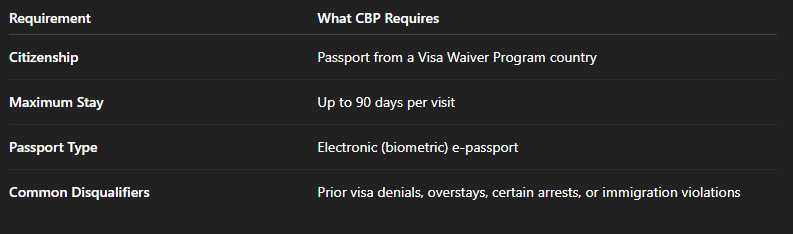
You are a citizen of a Visa Waiver Program country
Your trip is 90 days or less
You’re traveling for tourism, business meetings, or transit
You hold a valid biometric passport
A visa is the safer—or required—option if:
You plan to work, study, or stay long-term
You’ve had prior U.S. visa denials or overstays
Your travel purpose falls outside ESTA’s narrow limits
ESTA is not complicated—but it is strict. Used correctly, it’s one of the fastest ways into the United States. Used casually, it’s an easy way to be denied boarding before your trip even begins.
Frequently Asked Questions (FAQ)
1. Is ESTA the same as a U.S. visa?
No. ESTA is not a visa. It is an electronic travel authorization required for eligible travelers visiting the U.S. under the Visa Waiver Program. It allows you to travel to a U.S. port of entry without a visa, but final admission is still decided by a CBP officer.
2. How long does ESTA approval take?
Many ESTA applications are approved within minutes, but some can take up to 72 hours if additional review is required. This is why CBP recommends applying well before your travel date—even if your trip is not fully confirmed.
3. Can I work or study in the U.S. with ESTA?
No. ESTA only permits tourism, business meetings, or transit. Any form of paid work, freelance activity, or academic study requires the appropriate U.S. visa. Using ESTA for these purposes can lead to denial of entry and future travel restrictions.
4. Do I need a new ESTA if I get a new passport?
Yes. ESTA is tied directly to your passport. If you receive a new passport, change your name, or update your citizenship details, you must submit a new ESTA application, even if your previous one had time remaining.
5. What happens if my ESTA application is denied?
If your ESTA is denied, you cannot travel under the Visa Waiver Program. You may still apply for a U.S. visitor visa (such as a B-1/B-2) through a U.S. embassy or consulate. In most cases, only the processing fee is charged for denied ESTA applications.
Welcome to the VisaTravel blog. We know that navigating the maze of visa applications and online forms can be as tricky as choosing the perfect travel playlist (which is all we want you worrying about anyway).
Throughout our years of experience, though, we’ve uncovered a mountain of knowledge which, via this blog, we’re sharing with you! Whether you're diving into the world of travel visas, wondering about the ESTA online hustle, or just trying to figure out the DS160 form, think of us as your online concierge, here to make the process easy and most of all, clear.
At this point in our global context, who has time for endless paperwork and confusing legal jargon? No one. That's why we're all about spilling the tea on online visa hacks, easier-to-work-with DS160 forms, and giving you tips on everything from tourist visas to immigration, to that last-minute ESTA online adventure.
So, just plug in a word you’re curious about on the search bar, and boom. We've got the tips, tricks, and insider info to help you (and anyone else you may be traveling with) get to your travel destination with the confidence of a seasoned traveler.

 U.S. Visa
 Canada eTA
 Schengen Visa
 New Zealand eTA
 United Kingdom eTA
 Australia eVisitor
 Vietnam eVisa
 Egypt eVisa
 Singapore Arrival Card
 Sri Lanka eVisa