
 U.S. Visa
 Canada eTA
 Schengen Visa
 New Zealand eTA
 United Kingdom eTA
 Australia eVisitor
 Vietnam eVisa
 Egypt eVisa
 Singapore Arrival Card
 Sri Lanka eVisa



--------- Spain’s Bold Migration Gamble: Opportunity, Bottlenecks, and a Divided Nation
Apr 23, 2026
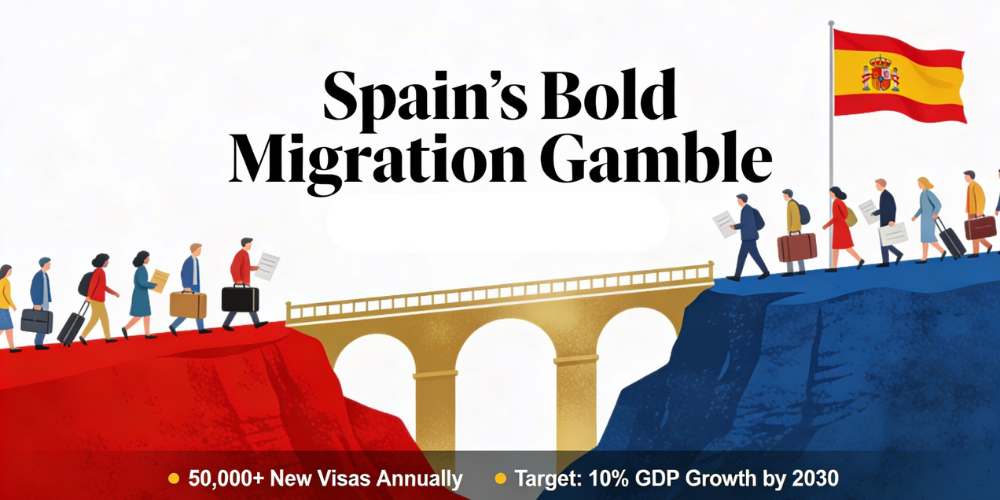
In a Europe increasingly defined by tighter borders, Spain is doing something radically different—opening a legal pathway for hundreds of thousands of undocumented migrants. It’s ambitious. It’s controversial. And right now, it’s chaotic.
A Historic Regularisation Plan Takes Center Stage
Spain has launched a sweeping immigration program aimed at granting legal status to up to 500,000 undocumented migrants—one of the greatest efforts of its kind in Europe in recent years.
Under the scheme, migrants can apply for a one-year renewable residence permit if they meet three core conditions:
- Proof they arrived before December 31, 2025
- At least five months of residence in Spain
- A clean criminal record
Applications are open until June 2026, with submissions accepted online and across hundreds of government offices.
The goal is clear: bring workers out of the shadows, plug labor shortages, and boost tax revenues.
The Human Rush: Long Queues, Complex Rules
On paper, the policy promises inclusion. On the ground, it’s a logistical marathon.
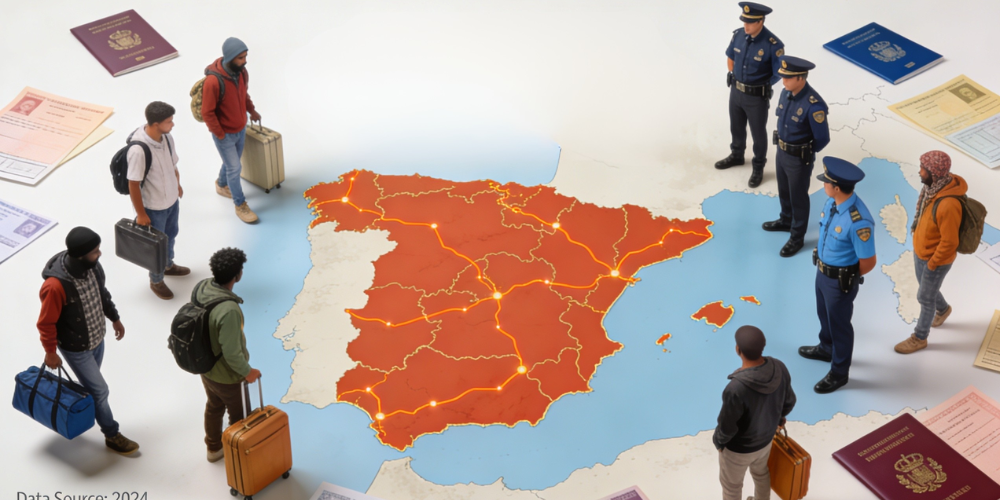
Across cities like Madrid and Barcelona, migrants are lining up for hours—sometimes over five hours—just to secure basic documents needed for their applications.
The process itself is anything but simple. Applicants must gather proof of residence—sometimes as specific as public transport usage records—alongside other official paperwork.
The result?
- Overwhelmed offices
- Confusing requirements
- Heavy reliance on NGOs and legal assistance
For many, the system feels like a race against time—and bureaucracy.
Why Spain Is Doing This
The Spanish government, led by Pedro Sánchez, is framing the move as both moral and economic policy.
Their argument:
- Migrants are already working in key sectors like agriculture, hospitality, and care work
- Legal status means better labor protections and higher tax contributions
- Integration strengthens the broader economy
There’s precedent. Previous regularisation programs in Spain have reportedly increased tax revenues and improved workforce stability.
In Sánchez’s words, recognizing rights shouldn’t be seen as radical—it’s pragmatic governance.
Political Backlash: A Nation Divided
Not everyone is on board.
Conservative and far-right parties argue that the policy could:
- Strain public services
- Encourage more irregular migration
- Undermine immigration control
Critics have gone further, framing the move as a demographic and political risk.
The result is a sharply polarized debate—one that mirrors broader tensions across Europe.
Migrants’ Perspective: Hope Over Uncertainty
For migrants themselves, the stakes are deeply personal.
Many see the program as a once-in-a-lifetime opportunity:
- Legal work
- Financial stability
- The ability to support families back home
Despite the long queues and bureaucratic hurdles, the overwhelming sentiment is cautious optimism.
For thousands, this isn’t just policy—it’s a pathway to belonging.
The Bigger Picture: A European Outlier
Spain’s approach stands in stark contrast to much of Europe, where governments are tightening borders and increasing deportations.
If successful, this program could:
- Redefine how countries handle undocumented populations
- Influence future EU migration policy
- Shift the narrative from enforcement to integration
But that success hinges on execution—and right now, the system is under serious strain.
Final Take
Spain’s migration gamble is bold, strategic, and undeniably human.
It’s a policy built on inclusion—but tested by reality.
If the government can streamline the process and manage the surge, this could become a blueprint for modern migration policy. If not, it risks becoming a cautionary tale of ambition colliding with bureaucracy.
FAQ Section
1. What is Spain’s new immigration regularisation program?
Spain has introduced a large-scale policy allowing up to 500,000 undocumented migrants to apply for legal residency, provided they meet specific requirements such as proof of residence and a clean criminal record.
2. Who qualifies for Spain’s regularisation scheme?
Applicants must prove they were in Spain before December 31, 2025, have lived in the country for at least five months, and have no criminal record.
3. How long does the residence permit last?
Successful applicants receive a one-year renewable residence permit, which can be extended if conditions continue to be met.
4. Why is Spain implementing this policy?
The government aims to address labor shortages, improve tax contributions, and integrate undocumented workers into the formal economy.
5. What challenges are migrants facing during the process?
Many applicants are dealing with long queues, complex documentation requirements, and delays due to overwhelmed administrative offices.
Recent Articles

U.S. May End “Duration of Status” for International Students: What It Could Mean in 2026
International students in the United States may soon face one of the most consequential immigration
U.S. Immigration Tightens Again: What “Enhanced Security Checks” Mean for Applicants in 2026
The United States has just added another layer to its already tightening immigration system—and th
Spain’s Bold Migration Gamble: Opportunity, Bottlenecks, and a Divided Nation
In a Europe increasingly defined by tighter borders, Spain is doing something radically different—

Australia’s Immigration Debate Heats Up: Policy, Politics, and the Battle Over “Values”
Australia’s immigration debate has taken a sharper, more polarised turn after the opposition Coali

Spain’s Bold Immigration Pivot: Legalization Plan Signals a New Direction for Europe
In a moment when much of Europe is tightening its borders and hardening migration policies, Spain is

Europe’s New Entry/Exit System (EES): What Travelers Need to Know in 2026
The ink stamp is fading into history. In its place? Cameras, scanners, and a system that remembers e
Read More
U.S. May End “Duration of Status” for International Students: What It Could Mean in 2026
U.S. Immigration Tightens Again: What “Enhanced Security Checks” Mean for Applicants in 2026
Spain’s Bold Migration Gamble: Opportunity, Bottlenecks, and a Divided Nation
Australia’s Immigration Debate Heats Up: Policy, Politics, and the Battle Over “Values”
Spain’s Bold Immigration Pivot: Legalization Plan Signals a New Direction for Europe
Europe’s New Entry/Exit System (EES): What Travelers Need to Know in 2026

Welcome to the VisaTravel blog. We know that navigating the maze of visa applications and online forms can be as tricky as choosing the perfect travel playlist (which is all we want you worrying about anyway).
Throughout our years of experience, though, we’ve uncovered a mountain of knowledge which, via this blog, we’re sharing with you! Whether you're diving into the world of travel visas, wondering about the ESTA online hustle, or just trying to figure out the DS160 form, think of us as your online concierge, here to make the process easy and most of all, clear.
At this point in our global context, who has time for endless paperwork and confusing legal jargon? No one. That's why we're all about spilling the tea on online visa hacks, easier-to-work-with DS160 forms, and giving you tips on everything from tourist visas to immigration, to that last-minute ESTA online adventure.
So, just plug in a word you’re curious about on the search bar, and boom. We've got the tips, tricks, and insider info to help you (and anyone else you may be traveling with) get to your travel destination with the confidence of a seasoned traveler.
Now go explore!